
Designed to Travel
Designed to Travel
Designed to Travel
Role / Title
Director, Brand & Creative
Company
Articulate
Industry
EdTech
Year
2026
Project
Articuland 2026 Global Series
Role / Title
Director, Brand & Creative
Company
Articulate
Industry
EdTech
Year
2026
Project
Articuland 2026 Global Series
Role / Title
Director, Brand & Creative
Company
Articulate
Industry
EdTech
Year
2026
Project
Articuland 2026 Global Series
Last year's event felt like proof nothing needed to change. It was luck, not a system, and luck wasn't going to hold across four new cities.
Articulate is an e-learning software company serving 150 million learners. It's moving through a new chapter all at once, repositioning and rebranding for the AI era, overhauling the product itself, and expanding from a US-based category leader into a global brand reaching audiences it's never spoken to before.
Articuland's first Tour and Summit season (2025) had worked, but it had worked through improvisation, a shoestring effort that depended on people compensating for gaps in real time. Nobody on the events, marketing, or design side saw a reason to change something that had just succeeded. Expanding into four new (global) cities and repositioning the series from a user conference into more of an industry event meant luck wasn't survivable this time (especially in markets where audiences had never heard of Articulate at all).
01.
Context
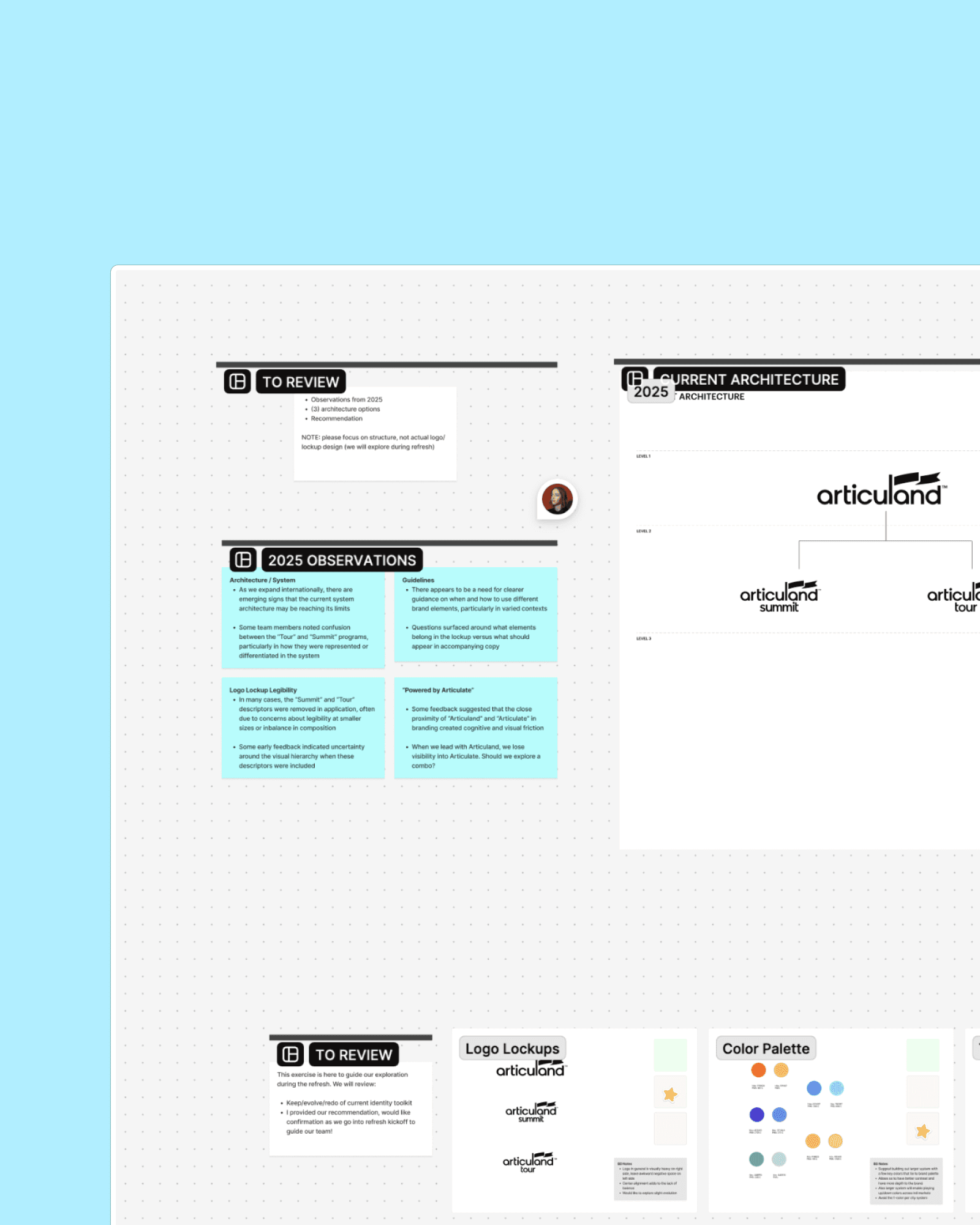
Articuland had two event formats and five names, and even internal teams couldn't reliably explain the difference between them. The 2-day flagship was called Summit. The five separate 1-day events were called Tours. All of it lived under the Articuland name, and only if you already knew Articulate could you make the connection to "Articuland" at all. None of that had mattered while the series stayed domestic and ran vibes instead of revenue goals.
02.
Problem
The events team, marketing leadership, and design leadership had all just watched Articuland's first season succeed, and success is a hard thing to argue with. Nobody was asking for a rebrand or more definition across strategy, positioning, audience, and expression. Getting anyone to sign off on a rebuild meant first convincing people it was needed at all.
03.
How I Moved the Org
Getting buy-in started with a retrospective. I walked the CCO and VP of Design through exactly what had broken last year, then brought them a complete refresh plan already built out rather than a set of open questions for the events team to sit with. Taking full ownership of the plan meant the events team never had to carry that uncertainty themselves, and having the credibility inside the business to run it that way is what got two executives comfortable saying yes to something nobody had asked for.
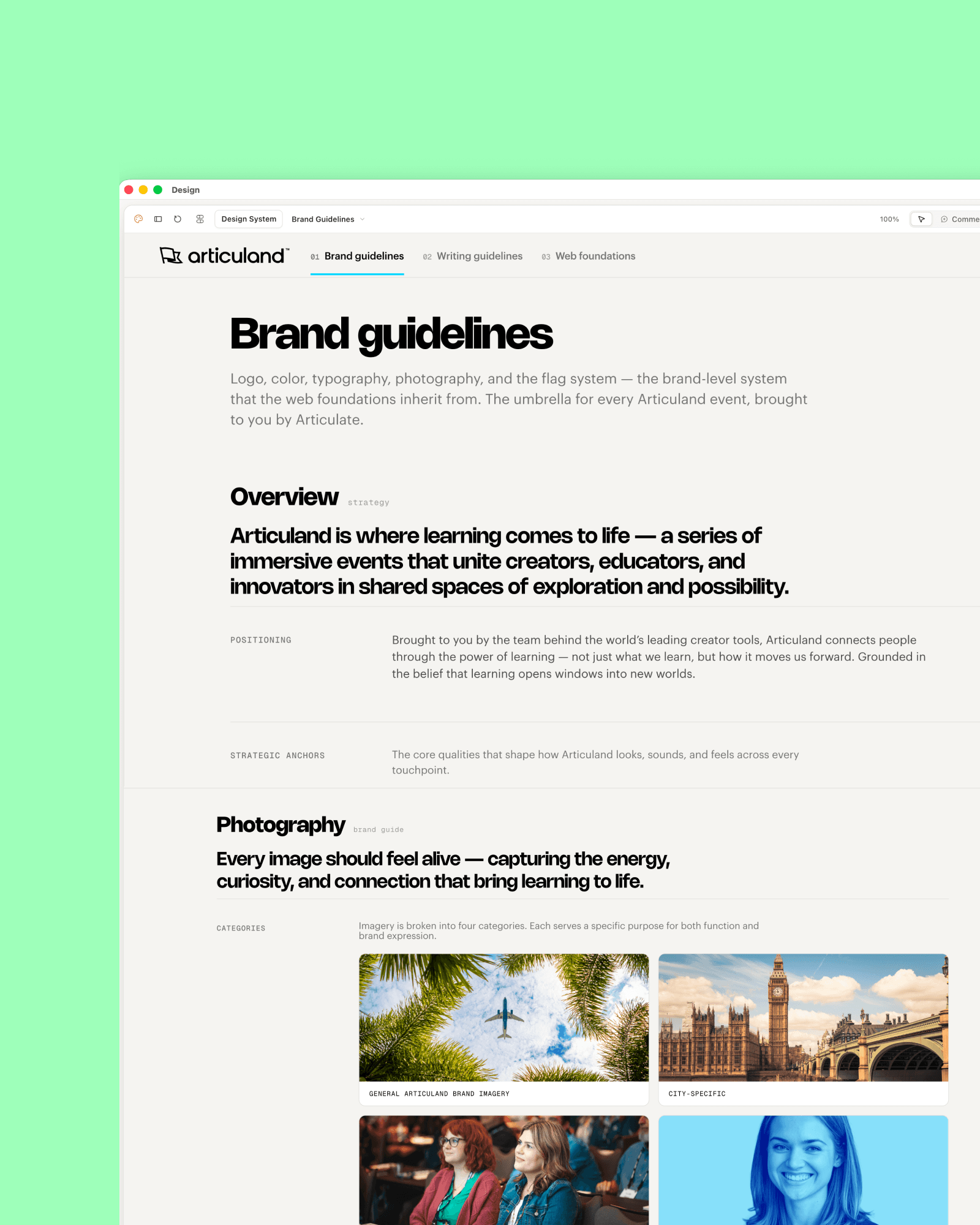
That alignment covered nomenclature and event hierarchy: one Articuland, no sub-brands, no competing names. I led the full system build from there, a constrained-vs-flex framework holding creative direction and motion principles globally consistent while leaving room for local cultural nuance, plus a global playbook so local teams and vendors could execute without brand drift across time zones and agencies.
The system read as distinct from Articulate's core brand while still holding together across every market it had to work in. It also did something the old shoestring version never had: it got the internal team excited about what came next instead of dreading another year of improvising.
01.
Context
Articuland had two event formats and five names, and even internal teams couldn't reliably explain the difference between them. The 2-day flagship was called Summit. The five separate 1-day events were called Tours. All of it lived under the Articuland name, and only if you already knew Articulate could you make the connection to "Articuland" at all. None of that had mattered while the series stayed domestic and ran vibes instead of revenue goals.
02.
Problem
The events team, marketing leadership, and design leadership had all just watched Articuland's first season succeed, and success is a hard thing to argue with. Nobody was asking for a rebrand or more definition across strategy, positioning, audience, and expression. Getting anyone to sign off on a rebuild meant first convincing people it was needed at all.
03.
How I Moved the Org
Getting buy-in started with a retrospective. I walked the CCO and VP of Design through exactly what had broken last year, then brought them a complete refresh plan already built out rather than a set of open questions for the events team to sit with. Taking full ownership of the plan meant the events team never had to carry that uncertainty themselves, and having the credibility inside the business to run it that way is what got two executives comfortable saying yes to something nobody had asked for.
That alignment covered nomenclature and event hierarchy: one Articuland, no sub-brands, no competing names. I led the full system build from there, a constrained-vs-flex framework holding creative direction and motion principles globally consistent while leaving room for local cultural nuance, plus a global playbook so local teams and vendors could execute without brand drift across time zones and agencies.
The system read as distinct from Articulate's core brand while still holding together across every market it had to work in. It also did something the old shoestring version never had: it got the internal team excited about what came next instead of dreading another year of improvising.
01.
Context
Articuland had two event formats and five names, and even internal teams couldn't reliably explain the difference between them. The 2-day flagship was called Summit. The five separate 1-day events were called Tours. All of it lived under the Articuland name, and only if you already knew Articulate could you make the connection to "Articuland" at all. None of that had mattered while the series stayed domestic and ran vibes instead of revenue goals.
02.
Problem
The events team, marketing leadership, and design leadership had all just watched Articuland's first season succeed, and success is a hard thing to argue with. Nobody was asking for a rebrand or more definition across strategy, positioning, audience, and expression. Getting anyone to sign off on a rebuild meant first convincing people it was needed at all.
03.
How I Moved the Org
Getting buy-in started with a retrospective. I walked the CCO and VP of Design through exactly what had broken last year, then brought them a complete refresh plan already built out rather than a set of open questions for the events team to sit with. Taking full ownership of the plan meant the events team never had to carry that uncertainty themselves, and having the credibility inside the business to run it that way is what got two executives comfortable saying yes to something nobody had asked for.
That alignment covered nomenclature and event hierarchy: one Articuland, no sub-brands, no competing names. I led the full system build from there, a constrained-vs-flex framework holding creative direction and motion principles globally consistent while leaving room for local cultural nuance, plus a global playbook so local teams and vendors could execute without brand drift across time zones and agencies.
The system read as distinct from Articulate's core brand while still holding together across every market it had to work in. It also did something the old shoestring version never had: it got the internal team excited about what came next instead of dreading another year of improvising.
The Proof
3
International cities added to the expansion
5 → 1
Event formats/names unified into one brand system
4
External partners enabled through rebrand playbook
30+
External speakers from companies outside Articulate
The Proof
3
International cities added to the expansion
5 → 1
Event formats/names unified into one brand system
4
External partners enabled through rebrand playbook
30+
External speakers from companies outside Articulate
The Proof
3
International cities added to the expansion
5 → 1
Event formats/names unified into one brand system
4
External partners enabled through rebrand playbook
30+
External speakers from companies outside Articulate
"We put out RFPs for events like this constantly, and most clients hand you a brand deck and a wish list. Articulate handed us an actual playbook, creative direction, motion principles, guardrails built for four new markets, all worked out before we'd even won the business. It's the best playbook we've ever been handed as part of an RFP, and it made scoping the work faster and more accurate than it usually is."
Bishop McCann
Event Production Partner
"We put out RFPs for events like this constantly, and most clients hand you a brand deck and a wish list. Articulate handed us an actual playbook, creative direction, motion principles, guardrails built for four new markets, all worked out before we'd even won the business. It's the best playbook we've ever been handed as part of an RFP, and it made scoping the work faster and more accurate than it usually is."
Bishop McCann
Event Production Partner
"We put out RFPs for events like this constantly, and most clients hand you a brand deck and a wish list. Articulate handed us an actual playbook, creative direction, motion principles, guardrails built for four new markets, all worked out before we'd even won the business. It's the best playbook we've ever been handed as part of an RFP, and it made scoping the work faster and more accurate than it usually is."
Bishop McCann
Event Production Partner
